

Lasting Power of Attorney

Why the Need for Lasting Power of Attorney
There may come a time when you cannot speak for yourself, an accident, an illness, a slow decline that no one saw coming.
Without a Lasting Power of Attorney, no one you trust has the legal right to step in. Not your spouse. Not your children.
No one — unless you choose them in advance.
Two types of LPA
Health & Welfare LPA
Covers the deeply personal decisions:
Medical treatment and ongoing care
Daily routines and personal welfare
Life-sustaining treatment decisions
Where you live
Can only be used when you lack the capacity to decide for yourself.
Property & Financial Affairs LPA
Covers the practical matters:
Bank accounts and savings
Paying bills and managing expenses
Property decisions
Investments and pensions
Can be used while you still have capacity — if you choose to allow it.

The Office of the Public Guardian
All LPAs must be registered with the Office of the Public Guardian (OPG). The OPG exists to protect those who cannot protect themselves.
The OPG’s role
Maintains the official register of all LPAs
Supervises attorneys to ensure they act properly
Investigates concerns raised about an attorney’s conduct
Has the authority to intervene where abuse is suspected
The process
Setting up an LPA is not complex, but it does require thought.
Choose your attorneys
The people you trust to act in your best interests. You can appoint more than one, and decide whether they act together or independently.
Select a certificate provider
An independent person who confirms you understand the LPA and are not being pressured. This is a safeguard built into the process.
Register with the OPG
The LPA must be registered before it can be used. Registration confirms everything is in order and places it on the official record.
LPAs allow you to avoid the Court of Protection by choosing in advance who can act for you.
It is one of the simplest and most important steps in any legacy plan.
This is not about losing control, it is about deciding — while you can — who holds it when you cannot.
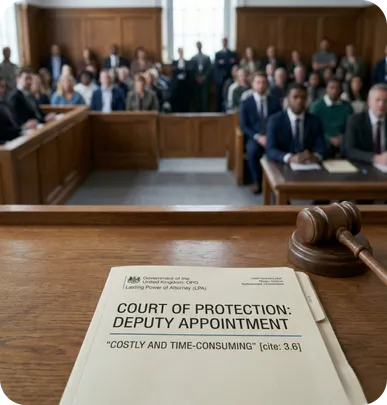
Without an LPA
If you lose capacity without an LPA in place, the Court of Protection takes over. This means decisions about your life, your money, your care, your home are made by strangers.
It is costly. It is time-consuming and it removes choice from the people who know you best.